
Stranger Stars #03: Building Factions & Creating Planets
A key part of any setting-focused roleplaying game is… well… actually building that setting. For Stranger Stars, I’m hoping to strike my preferred balance of in-text worldbuilding which is enough to understand and envision a majority of the universe while leaving plenty of voids to be filled in at each table during play (or by the GM during their prep, if desired). Ideally, that will be something a bit more expansive than MÖRK BORG’s world information (12 or so pages in the BAREBONES EDITION) but far more streamlined/focused than a trad game’s setting section (which can easily be hundreds of pages long, if not being entire books unto themselves).
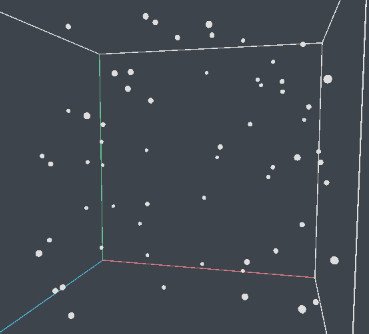
I’m toying with 3D point map representations for the “registered worlds.”
As it stands now, the setting information for Stranger Stars will include 5 major factions, 12 minor factions, and a very basic guide to all 63 of the galaxy’s “registered worlds."
First, let’s dive into the factions. Here’s a preview of the galaxy’s major players:
Frontier Dawn Security: The New World’s premiere, for-profit defense force
United Planetary Front: Freedom fighters, building a new order under new stars
Church of the Navigator: Ultrawealthy pilgrim fleet and galaxy’s most populous religion
Dextro-Singleton Spatial Solutions: Shipping/logistics company turned everything corporation after the Collapse
Hanto Omnidimensional Industries: Mining/manufacturing corporation
With these starting factions, I’m looking to build out each one to include several paragraphs of overview text, a number of shared statistics, one unique statistic playing into each faction’s overall vibe/focus, and then 1-3 notable NPCs (the kind of power players most galactic denizens would have at least heard of/see in the news semi-frequently).
Here’s what Frontier Dawn Security is looking like, at the moment:
Frontier Dawn Security
The New Worlds’ premiere, for-profit defense force. While regularly employed by Dextro-Singleton, Hanto Omnidimensional, and other corporations across settled space, the Dawn follows its own ends first and profit second. Over the century since the Collapse, FDS has grown into an intergalactic nation all its own, giving its members structure and stability during those first chaotic decades.
Led by a suite of Commanders each overseeing their own Branch across the galaxy, FDS members work towards their Branch Commander’s goals first, profit second, and everything else third. Additionally, the semi-independent Branch structure gives FDS a unique advantage allowing one Branch to fight another when two or more Branches are employed by two or more sides of an armed conflict.
Inside FDS, every action a member takes is recorded, analyzed, and ranked. For this reason (alongside cross-Branch warfighting), there is massive internal competition, focused around semi-annual Branch Rankings. A true Soldier of the Dawn eats and breathes FDS.
Statistics:
- Registered Worlds: 10
- Capital Ships: 491
- Population: ~35,500,000,000
- Supermassive Nuclear Devices: ~300
Every faction will have Registered Worlds, Capital Ship, and Population statistics (with more possibly being added as I continue writing), but for FDS, “Supermassive Nuclear Devices” is their unique statistic - giving you a sense of their overall strength, the type of strength they cultivate, and how they wield their power.
Additionally, many of the major factions will align very closely to specific player classes. Most Soldiers likely have a past or current attachment to the FDS, as the galaxy’s largest military recruiter (though other standing armies do exist). The goal is to have the player classes, equipment, and factions all play off of and build upon one another to add even further detail and context without requiring players to read a massive wiki before play.
Beyond these major factions, I have basic notes for 12 minor factions as well, including 6 corporations, 1 political group, 2 religions, 2 resistance groups, and 1 mercenary company. These will be smaller in description and relevant power with a notable aspect to each, whether that be a standout NPC, a noteworthy planet, or a unique asset.
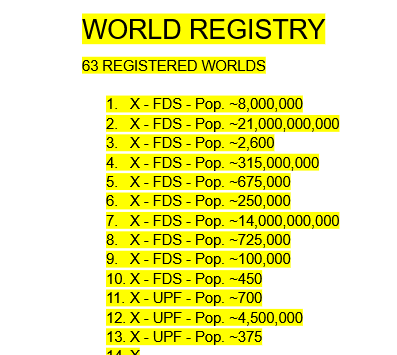
Early notes for the Stranger Stars World Registry.
Early on in faction writing, I decided I want to have a list and simplified map of all of the “Registered Worlds” - the known planet’s outwardly owned and operated by the galaxy’s various factions. Of course, this is space which means there are likely countless more planets and star systems between and beyond what will be listed here, but having a sizeable chunk of space realized is, I think, key to any good setting. Plus, I just love Eve Online’s galaxy map and wanted to create a small but mighty version of that for Stranger Stars.
To build this registry of worlds, I’m taking major inspiration from Classic Traveller’s Book 3 - Worlds and Adventures which is my go-to resources for any sort of planet building. It’s simply too good. Right now, I’m mostly getting a feel for the size and scale of the universe’s population, but in the end, I hope to have a list of 63 Registered Worlds placed on a point map (with connective jump points) and basic information for each world (population, size, resources, star type, etc.). While I want this to be a shortcut for GMs to have names and basic information for a wealth of worlds from the moment they start playing, I also want these worlds to add further context and shape to the various factions and the players’ roles within the universe.
Learning that the United Planetary Front has claimed 3 registered worlds may sound like a huge achievement (and it was hard fought for them, have no doubt) but when you learn they have a combined population of 4.5 million (about 0.01% the population of all the Frontier Dawn Security worlds) the size and scale of their continued struggle begins to fully take shape.
I’m working to have all of this world/setting information take up about… 24 pages or so all told. Something that could be easily read through in a short sitting and quickly referenced during play but chunky enough to include legwork to support a lot of play. I may be naive though in that size and scope and it may balloon from there, but no matter what I will be focusing on keeping it lean and mean.
I’m also dying to include some short/flash fiction within the book as I think it’s an entertaining way to add context while also motivating play, but that’s for a future post.
Thanks for reading! - Christian